24 Complex arithmetic and geometry
Cartesian and polar forms connect complex arithmetic with plane geometry, rotations, dot products, and cross products.
Exercises
Complex numbers
Exercise 24.1 Let \(z = x + \mathrm{i}y \in \mathbb{C}\), and compute the real and imaginary parts of \(z^2\), \(z^3\), and \(z^4\), as functions of \(x\) and \(y\).
Exercise 24.2 Compute a closed-form expression for the real and imaginary parts of \(z^n\).
Exercise 24.3 Compute closed-form expression for \(z^{-1}\), exhibiting the real and imaginary parts as functions of \(x\) and \(y\). (Assuming \(z\neq 0\)). Try to compute closed-form expressions of \(z^{-2}\) and \(z^n\) as well.
Exercise 24.4 A complex number \(z = x + \mathrm{i}y\) can be written in polar form, \[x = r \cos(\theta), \quad y = r \sin(\theta).\] Write down the rule for \(z^n = R\cos \phi + \mathrm{i}R\sin\phi\) using angle \(\theta\) and modulus \(r\).
Exercise 24.5 Consider the polynomial equation \(f(z) = z^3 + 1 = 0\). Find all the roots in the complex plane using polar coordinates. Sketch the roots in a coordinate system.
Basic calculations
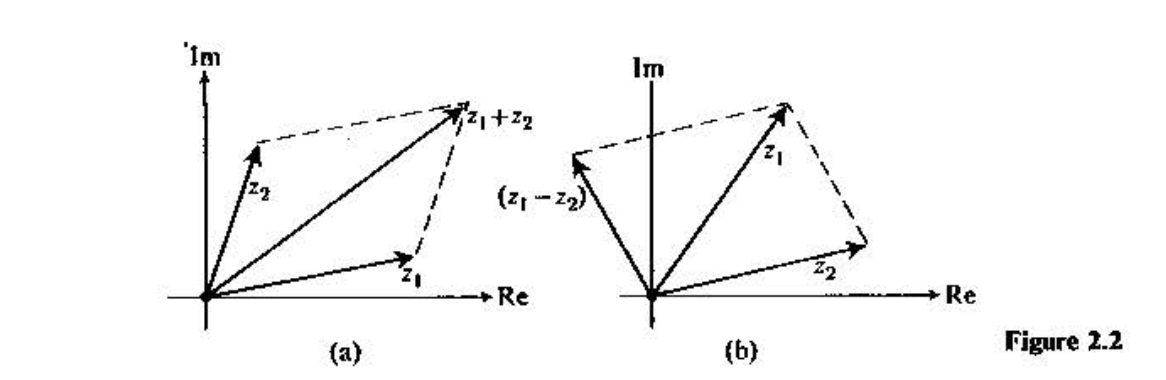
Exercise 24.6 Let \(z = x + \mathrm{i}y \in \mathbb{C}\). Illustrate the addition \(w = z + \bar{z}\) in a coordinate system using the parallelogram rule.
Exercise 24.7 Recall our earlier exercise, where \(\mathbb{C}\) was regarded as the real vector space \(\mathbb{R}^2\). Let \(z_i= x_i + \mathrm{i}y_i\), and denote the corresponding vectors in \(\mathbb{R}^2\) by \(\mathbf{v}_i\). Show that \[\left\langle\mathbf{v}_1,\mathbf{v}_2\right\rangle = \Re (\overline{z_1} z_2) = \Re (z_1 \overline{z}_2).\]
Exercise 24.8 Another product in \(\mathbb{R}^2\) (and indeed \(\mathbb{R}^3\)) is the cross product: \[\mathbf{v}_1\times \mathbf{v}_2 = \begin{vmatrix} v_{11} & v_{12} \\ v_{21} & v_{22} \end{vmatrix},\] the matrix determinant. Show that \[\mathbf{v}_1 \times \mathbf{v}_2 = \Im (\overline{z_1} z_2) = -\Im (z_1 \overline{z}_2).\]
Exercise 24.9 Show that the function \(z \mapsto \mathrm{i}z\) is a counterclockwise rotation by \(\pi/2\). Find the function that performs a clockwise rotation by the same angle.