18 Metric spaces
A metric measures distance through symmetry, positivity, and the triangle inequality.
A metric encodes the intuition behind measuring distances in a set \(M\). It is a distance function \(d(x,y)\), where \(x,y\in M\).
The definition of a metric space is as follows:
Definition: Metric. Let \(M\) be a set. A function \(d: M\times M \to \mathbb{R}\) is a metric if it satisfies the following axioms:
\(d(x,y) = d(y,x)\)
\(d(x,y) \geq 0\), and \(d(x,y) = 0\) if and only if \(x =y\)
\(d(x,y) \leq d(x,z) + d(z,y)\)
The pair \((M,d)\) is a metric space. If \(M\) is a vector space, we say that \((M,d)\) is a metric vector space.
In this exercise, we will try to understand why the axioms are as they are, i.e., what makes them encode the concept of a metric.
Exercises
Exercise 18.1
Consider two persons \(X\) and \(Y\) located at \(x\) and \(y\) in a set \(M\). They both measure the distance to the other person. What would happen if axiom a) is violated? Is this reasonable?
What would happen if axiom b) is violated? Is this reasonable?
A third person \(Z\) located at \(z\) enters the picture. Consider axiom c). What happens if this axiom is violated? Is this reasonable?
Let \(M = \mathbb{R}^2\), and let \(d\) be Euclidean distance, “as the crow flies”. But there are other distance measures as well. Consider for example the “Manhattan distance”, given by \[d(\mathbf{x},\mathbf{y}) = |x_1-y_1| + |x_2-y_2|.\] This has a standard interpretation in terms of cities with straight streets and taxis driving on these streets. Discuss.
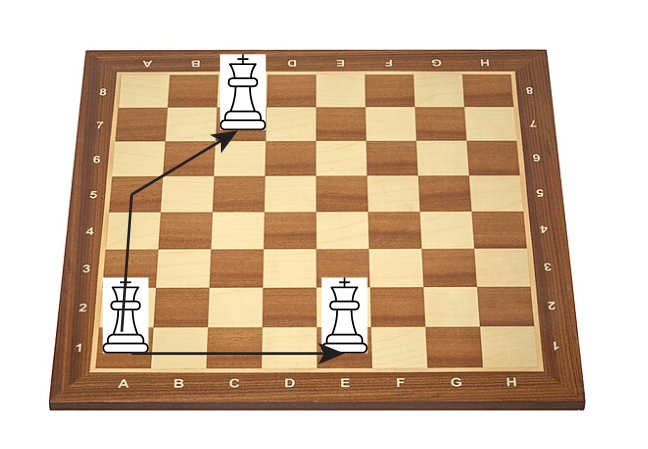
Consider a king moving on a chessboard. The king can move one step at a time, either horizontally or vertically, or diagonally. Consider the minimum number of steps the king has to move in order to get from one point to another. See Figure 18.1 for an illustration. The metric is \[d(\mathbf{x},\mathbf{y}) = \max (|x_1-y_1|, |x_2-y_2|).\] This is also called the “maximum metric”. Can you verify the metric axioms? How does the maximum metric compare to the Manhattan metric?