12 The integral
We now turn to actually defining the integral of a measurable function. One begins by defining the integral of simple functions.
Definition 12.1 (Simple functions) Let \((X,\boldsymbol{X})\) be a measurable space. Let \(f : X \to \mathbb{R}\) be a measurable function. We say that \(f\) is a simple function if it takes on only finitely many function values. The set of simple functions is denoted \(\mathcal{S}\). The set of non-negative simple functions is denoted \(\mathcal{S}^+\).
A simple measurable function has a unique decomposition as \[f = \sum_{i=1}^n c_i \chi_{U_i}, \quad U_i \in \boldsymbol{X}, \quad U_i \cap U_j = \emptyset.\]
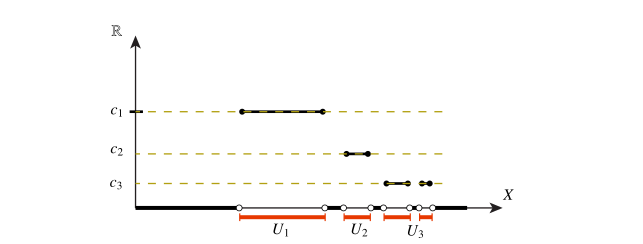
A simple function is illustrated in Figure 12.1. What should the integral of this simple function be? Clearly, the integral of the characteristic function \(\chi_U\) of some measurable \(U\) should be the volume, or measure, of \(U\)! We have to be careful, since the measure of \(U\) can be infinite.
Definition 12.2 (Integral of non-negative simple function) Let \((X,\boldsymbol{X},\mu)\) be a measure space. Let \(f : X \to \mathbb{R}\) be simple and non-negative. We define the integral of \(f\) to be the extended valued function \(I : \mathcal{S}^+ \to \mathbb{R}\cup\{+\infty\}\) given by, \[\int_X f \, \mathrm{d}\mu = I\left(\sum_i c_i \chi_{U_i}\right) = \sum_i c_i \, \mu(U_i).\] The function \(I\) is linear and monotone, \[f,g\in\mathcal{S}^+, \quad f \leq g \implies I(f) \leq I(g).\]
Let now \(f: X \to [0,+\infty[\) be a non-negative measurable function. It is implicit here, that we have the Borel \(\sigma\)-algebra on the real numbers. How do we define the integral? The idea is to approximate \(f\) by simple functions from below, and indeed this can always be done.
Definition 12.3 (Integral of non-neagative functions) Let \((X,\boldsymbol{X},\mu)\) be a measure space, and let \(f : X \to [0,+\infty[\) be measurable. We define the integral of \(f\) to be \[\int_X f \, \mathrm{d}\mu = \sup\left\{ I(h) \mid h \in \mathcal{S}^+ , \, h \leq f \right\} \in [0,\+\infty].\] The function \(f\) is integrable if \(\int_X f \, \mathrm{d}\mu < +\infty\).
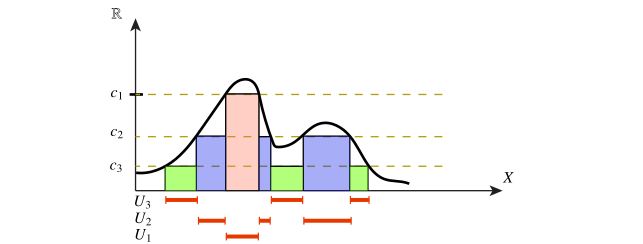
Thus, we take every non-negative simple function that lies below \(f\), compute the integral, and maximize over all such simple functions. If \(f\) can be approximated by simple functions, which it can, then the integral could and should converge. (The technical result that allows approximation from below in this way is the monotone convergence theorem.)
In Figure 12.2, the approximation of \(f\) by simple functions is illustrated. From this illustration we take home perhaps the most important intuition: Whereas the Riemann integral is defined in terms of approximating the are below the graph by vertical strips, the measure-theoretic integral instead consider horizontal strips!
In the next result, the phrase \(\mu\)-almost everywhere, abbreviated \(\mu\)-a.e., means that the condtion holds for every \(x \in X\) except possibly at a set of measure zero.
Theorem 12.1 (Properties of the integral) Let \((X,\boldsymbol{X},\mu)\) be a measure space, and let \(f \geq 0\) be a measurable function \(f : X \to \mathbb{R}\). The integral on such functions satisfies: Monotone: \[f \leq g \quad \text{measurable functions} \implies \int_X f\, \mathrm{d}\mu \leq \int_X f \, \mathrm{d}\mu\] Vanishing on set of measure zero: \[f = 0 \quad \text{$\mu$-a.e.} \iff \int_X f\, \mathrm{d}\mu = 0.\] Irrelevant on set of measure zero: \[f = g \quad \text{$\mu$-a.e.} \implies \int_X f \, \mathrm{d}\mu = \int_X \, \mathrm{d}\mu\]
The concept of “almost everywhere” is very important when Lebesgue integrals are considered. Whenever a function is only “used” to define integrals, it does not matter what the function values are at a set of measure zero. As we have seen, such sets can be fairly large!
We can now define the integral of arbitrary measurable functions.
Definition 12.4 (Integral) Let \((X,\boldsymbol{X},\mu)\) be a measure space, and let \(f : X \to \mathbb{R}\) be measurable. Let \(f_+\) and \(f_-\) be the positive, resp., negative part of \(f\). We define \(f\) to be integrable if \(f_+\) and \(f_-\) are ingegrable, and we define \[\int_X f \, \mathrm{d}\mu = \int_X f_+ \, \mathrm{d}\mu - \int_X f_-\,\mathrm{d}\mu.\]
s